Madison, Hamilton and Betsy Ross

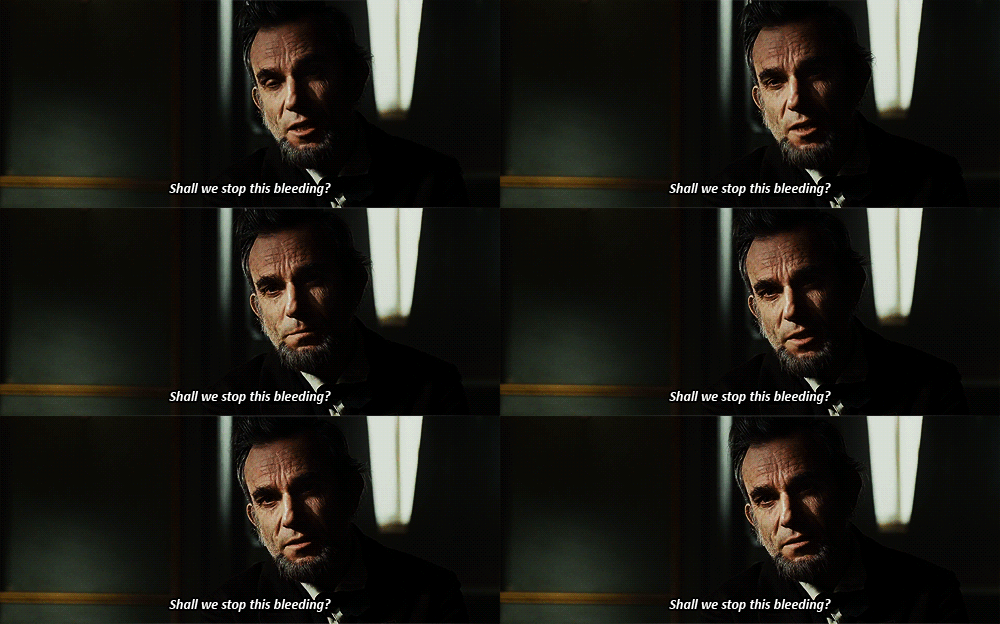
Now that some time has passed and the debate is digested(well, as digested as something both undercooked and over-spiced can be) we can officially declare political discourse dead. Wave goodbye to the romantic notions of debate: Lincoln/Douglas or Kennedy/Nixon. No more will rhetoric and language soar above the fight, highlighting vision and idealism. Now the fight is all there is. Now we fight over the facts that we want and the truth that suits us.

There’s nothing but Straw Men as far as I can see, all shouting at each other.  One hand pointing and accusing while the other hand is holding a torch threatening to “burn it all down!”  

Separation was sewn into our democracy by great minds like Madison and Hamilton in order to prevent abusive rule. The thought being that different agendas all coming together at the same time would create a stage for slow, thoughtful compromise. NOPE! Instead, it seems that that thread of Separation has frayed into Divisiveness. Two parties in such clear contention that neither can stand to hear the other side talk. Good ideas are stillborn in that kind of society.

Gesellschaft

German words are frightening. They jam as much consonants together as they possibly can. And usually the most jagged ones. It’s like getting on the 6-train during rush hour, nothing but elbows, knees and those pointy edges at the base of every book bag and purse. Nevertheless, German words are very specific. Whenever they cram all those letters together, they usually come up with an interesting word.

Gesellschaft is a group made up of different interests, norms and concerns all gathered in one area. Usually, the gesellschaft has an overarching goal, but it’s loosely defined. You can find a good example of a gesellschaft in an office environment. Everyone in the office is pressed together from different walks of life and then laden with slightly different tasks for some vague goal set by a faceless company or agency. Due to those conditions, it’s easy to understand how most offices devolve into laboratories for petty behavior and/or studies in social Darwinism.

Don’t get me wrong; I do not blame gesellschaft. It’s not his fault; the word basically can be broken down to mean society. I blame society. Societies are tough nuts to crack. For instance, the sum of all those differences in an office building multiplied by a thousand could equal America. And America is pretty complicated right? Some many people from so many different places and so many different understandings. It wouldn’t take much to cause that kind of large-scale gesellschaft to aimlessly stumble into division. Conversely, I can think of only one thing that could make it blossom into a collective and agile force for progress, overcoming the differences we have. My answer would be a sense of purpose, not just individually by way of personal achievement, but in the pleasure one gets from contribution. Maybe one day America will stop feeling like this giant office building crammed to capacity with individuals but without an actual common point of focus. Maybe one day all the different threads of humanity that America contains will weave into a particularly strong tapestry made possible by a galvanizing and shared purpose.

Shades of Severity

Dr. Jekyll said: “…I led a life of such severity as I had never before attained to, and enjoyed the compensations of an approving conscience.” Robert Louis Stevenson – The Strange Case of Dr. Jekyll and Mr. Hyde.

What is the value of an “approving conscience”? At what point does the freedom of mind and action become a hindrance to the soul? Moreover, when does the soul become the restraint to the freedom of mind and action? Dr. Jekyll struggled with these questions in the novel, but we all find that understanding difficult. As severity – in relation to the use of self-discipline – can often instruct us subjectively, one can decide that the moral position is determined best when an external power or holy power is in control; however, what if that authority seems to have abandoned you. If we woke up tomorrow and authority – both religiously and politically – were gone, would we regret the discipline and restraint of action that we showed during our lives or would we be stalwart in the standards of morality we accepted.

Estimate the Opponent

I’ve always said, “Underestimation can turn a farmer into a general”. To me, that maxim speaks to the severe danger of underestimating an “opponent” (I’m very competitive and slightly paranoid so I treat most people like opponents). And as I’ve applied the Never-Underestimate Philosophy to my life, with fruitful results, the philosophy is not FOOL-PROOF (pun intended). There will always be someone who’s talent or ability is worthy of UNDERestimation. Consequently, overestimation can create a detrimental blind-spot that could potentially lead to the downfall of any budding, young strategist. It’s a delicate understanding, but an important one. Chess seems to illustrate the point most clearly: during a game with a new opponent the advanced player can create an intricate strategy with built-in defenses against the most likely moves ahead, which only works if the other player knows the likely moves. If one player is better than the other, he or she can open-up a direct path to victory because he or she is guarding against more complicated routes. So when in business, sports or life, in general, the analysis of the opponent should take place at all levels of the game. Don’t over or under, just estimate the threat!

Classically Trained Bongoist

​What is wrong with the basics!  There is an important truth in the unaltered, unadjusted form.  I’m not saying improvement is wrong or that growth in concept or innovation is a bad thing, but what about that original concept.  When people refer to the basics or the fundamentals of something it is always perceivedas a starting point, but often times, we begin something only to realize we preferred how it all began to where it is now.  Human nature secretly yearns for the simplistic, but will never admit it for fear of being deemed simple.      

The Arts are the best medium to make my thoughts clearer, in particular the area of music. For instance, the bongo is an instrument rooted in simplicity: someone hits it and it makes noise. It’s a hollow, barrel-shaped structure with a fiber stretched across the top. Just hit the skin or fiber and the sound echoes, do it a bunch and it builds a rhythm. Simple and effective. However, I’m sure at some point in the bongo’s history someone thought to look into complicating the bongo. I’m sure someone spent countless hours devising a proper hand position to strike the bongo and terminology to explain said position or the scale the bongo should register in or something along those lines. Ultimately, the elegance of this seemingly rudimentary instrument was lost. Now I don’t pretend that an expansion of understanding about a subject ruins it; I only mean to state that a simplification of a subject doesn’t always mean a regression.

There was a time – as science and technology slept like the proverbial dragon atop of a wealth knowledge and understanding – that Arts like literature and music were left to develop and grow without the skepticism they now face about their overall knowledge value. That time was spent over-analyzing the many art forms instead of solidifying the simple connections that aesthetics and expression have with the Human Spirit. Consequently, as technology continues to march us closer and closer to some sort of Terminator-esque Doomscapelittered with the corpses of our murdered Privacy and starved Discovery there is no foil in sight. There is no cry for the simple beautiful picture or poem or the pure sound that comes from the heroic Bongo.

Dis-Harmony: A Counter Culture Blog

   Humans can animate anything.  We move within this planet and this Universe mingling and separating from each other all the while breathing life into ACTIONS and OBJECTS! Often times, the friction or magnetism between these Actions and Objects can spark an evolution to an even higher form of life called Culture.  This aggregate cloud composed of humans and human nature and human creation float about with only the steady harmony of Universe to rely on.  A harmony that connects everything!

Hello! My name is Edwin E Cadiz and this blog defines and dissects Culture by challenging the Actions and Objects as well as the people that create them. More than being a Counter-Culture blog in the sense of comprehending the contrary, I hope to strike opposing notes in the very harmony of the Universe just to see what happens next.

   Welcome to Strip Clubs are Sad Discos!  A Blog for the evolving and challenging mind. Questions everything, but don’t take anything too seriously!